Open Nav

When a PCB fails inside a consumer gadget, the consequence is inconvenience. When a PCB fails inside an implantable cardiac defibrillator, a critical care ventilator, or an infusion pump delivering chemotherapy, the consequence is measured in human lives. The regulatory, material, and process standards that govern the design and manufacture of PCBs for life-critical medical devices reflect this difference in stakes. For healthcare electronics manufacturers building products where failure is not an option, understanding the applicable standards — and understanding how Hdi Technology intersects with those standards — is not a compliance exercise. It is a prerequisite for building products that actually work when the margin for error is zero.
Medical devices sold in the United States are regulated by the Food and Drug Administration under the Federal Food, Drug, and Cosmetic Act. Devices are classified by risk, with Class I representing the lowest-risk products and Class III representing the highest-risk devices that require Premarket Approval (PMA) before they can be marketed. Many life-critical healthcare electronics — implantable devices, critical care monitors, surgical instruments with electronic components — fall into Class II or Class III categories.
The FDA's Quality System Regulation (21 CFR Part 820) requires manufacturers to establish and maintain quality systems that ensure products meet their intended specifications. In practice, this means that the Pcb Manufacturing process for a medical device must be documented, validated, and subject to change control from initial design through end of life. The IEC 60601 series sets the particular safety and performance standards for electrical medical equipment, with different standards in the 60601-2x series addressing specific device types — infusion pumps, patient monitors, surgical equipment.
ISO 13485 is the internationally recognized Quality Management System standard for medical device manufacturers. While it does not prescribe specific PCB requirements, it mandates that the manufacturing process be documented, that supplier quality be managed, that incoming inspection and in-process controls be defined, and that traceability be maintained to the component and lot level. For PCB assembly, ISO 13485 compliance means that the CM must demonstrate process capability, maintain equipment calibration records, and produce documentation that allows a defective board to be traced back to the specific production lot, shift, and process parameters that produced it.
High Density Interconnect PCB technology has become essential in Medical Electronics for the same reasons it has become essential in consumer devices: Miniaturization. Implantable devices such as pacemakers, neurostimulators, and implantable loop recorders must fit inside small housings that can be implanted with minimally invasive procedures. Portable diagnostic devices — blood glucose monitors, pulse oximeters, wearable cardiac monitors — are expected to deliver smartphone-level functionality from a device small enough to wear continuously. Hdi Boards with Microvia structures enable this Miniaturization by allowing more functionality to be packed into smaller board areas and by enabling package-on-package and chip-on-board architectures that reduce the footprint of the Electronics Assembly.
But Hdi Technology brings manufacturing complexity that must be carefully managed to meet the reliability requirements of life-critical devices. Microvia structures — particularly stacked Microvias that connect multiple consecutive layers — introduce additional process steps and additional interfaces between materials that can be sites of failure under thermal cycling. The fine line widths and spacings that HDI enables require tighter fabrication tolerances, more precise registration, and more controlled process parameters than conventional multilayer boards. All of these complexities must be validated and controlled to the same reliability standard as simpler board constructions.
The IPC (Institute for Printed Circuits) industry association publishes the most widely referenced standards for Pcb Design, fabrication, and assembly. For Medical Electronics, the most relevant IPC standards are IPC-6012 (Qualification and Performance Specification for Rigid Printed Boards) and IPC-A-610 (Acceptability of Electronic Assemblies).
IPC-6012 defines three classes of PCB quality requirements, corresponding to the three general levels of electronic product reliability: Class 1 for consumer products, Class 2 for dedicated service products, and Class 3 for high-reliability electronics where continued performance or performance on demand is critical. Life-critical healthcare equipment falls squarely into Class 3 requirements. The differences between Class 2 and Class 3 are substantial: Class 3 requires 100 percent of all nets to be tested for opens, tighter Annular Ring requirements, higher plating thickness minimums for vias, and more stringent acceptance criteria for surface conditions, edge cuts, and internal anomalies detected by microsectioning.
For Hdi Boards, IPC-2226 — the HDI design standard — provides layer-by-layer build-up structure definitions and design parameters. It defines microvia types (Type I through Type IV based on how the microvia is formed and how it connects layers) and sets the minimum design constraints for each type. Adherence to IPC-2226 design rules does not automatically guarantee compliance with IPC-6012 Class 3 fabrication requirements, but it provides the design foundation upon which the fabrication and inspection requirements are built.
The laminate material in a medical PCB must meet multiple requirements that are not always aligned. It must be dimensionally stable across the operating temperature range to maintain registration of fine features. It must be compatible with the plating processes used to form microvia barrels and through-hole plating. It must meet the flammability requirements of the applicable safety standard. And, for boards used inside devices that will be implanted or that contact the patient, it must be biocompatible or adequately separated from patient contact by the device enclosure.
The most common laminate systems for medical HDI boards are based on high-Tg epoxy resins reinforced with non-woven aramid or polyester — materials that offer better dimensional stability than standard FR-4 during the lamination cycles required for HDI build-up. Polyimide-based laminates offer the highest thermal capability and are commonly specified for boards that will undergo multiple high-temperature assembly cycles or for applications with extended high-temperature exposure. Liquid Crystal Polymer (LCP) substrates are increasingly used in very high-frequency medical applications such as implantable telemetry modules, where the dielectric properties of conventional epoxies introduce unacceptable signal loss.
Halogen-free materials are increasingly specified in medical applications driven by concerns about toxic gas release during fires — a relevant scenario in operating room environments where electronic equipment operates in oxygen-rich atmospheres. Laminates meeting UL94 V-0 flammability rating without halogenated flame retardants are now available from all major laminate suppliers and are a practical requirement for many medical device programs.
Process validation is the cornerstone of reliability assurance for medical PCB assembly. Unlike commercial electronics where defects can often be screened out through end-of-line testing, medical electronics manufacturers must demonstrate that the manufacturing process itself is capable of producing boards that meet their specifications consistently — not just that the boards produced today happen to pass inspection.
The FDA's process validation guidance divides validation into Installation Qualification (IQ), Operational Qualification (OQ), and Process Performance Qualification (PQ). For PCB assembly, IQ covers the installation and calibration of equipment — reflow oven temperature profiles, placement machine accuracy specifications, AOI and X-ray Inspection system calibration. OQ establishes that the equipment operates within specified parameters — for instance, that the reflow oven maintains temperature within ±2 degrees Celsius of setpoint across all zones during steady-state operation. PQ demonstrates that the process produces boards meeting their quality requirements over time, typically through statistical process control data collected across multiple production lots.
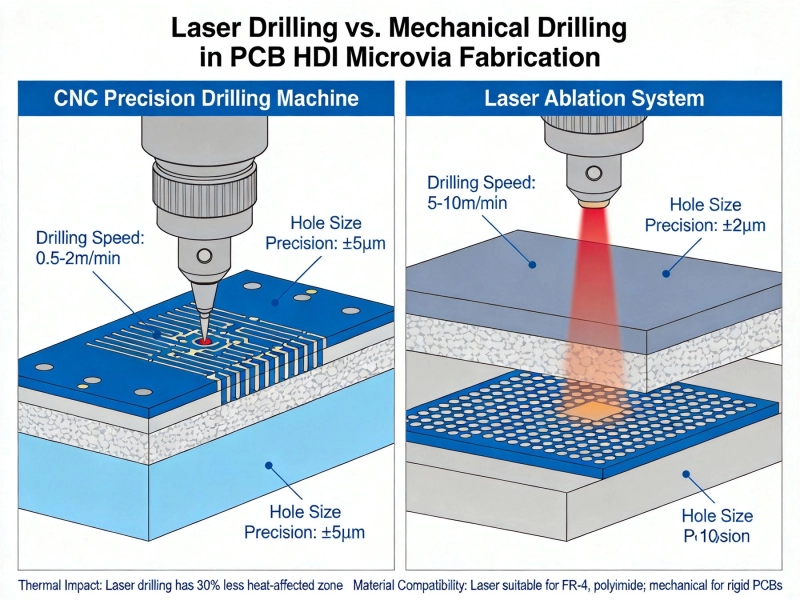
For HDI microvia assemblies, the specific process parameters that must be validated include Laser Drilling pulse energy and repetition rate, desmear and electroless Copper Plating deposition rates, and lamination temperature and pressure profiles for each lamination cycle in the build-up sequence. These parameters are often specified as operating ranges rather than fixed values, and the validation must demonstrate that the process remains capable of producing acceptable boards across the full range of specified parameters, not just at a single nominal setting.
The microvia is simultaneously the enabling technology of HDI and one of its primary reliability risks in life-critical applications. Microvia failures under thermal cycling — barrel cracks, pad lift, delamination at the interface between the via barrel and the pad land — are well-documented failure modes that have received significant attention in the electronics industry over the past two decades. For medical devices that may be implanted for five to ten years or more, or for portable devices that undergo daily charge-discharge cycles, Microvia Reliability is not optional — it is existential for the product.
The primary mitigation for Microvia Reliability risk is process validation combined with thermal cycling testing. A board that passes 500 thermal cycles from -40 to +125 degrees Celsius without any microvia failures has demonstrated a level of reliability appropriate for most life-critical applications. For boards with stacked microvia architectures — where Microvias are stacked directly on top of each other across multiple layers — more conservative test criteria are warranted, as stacked configurations concentrate stress at the interface between stacked structures.
X-ray Inspection and cross-sectional analysis are the primary tools for validating microvia quality during process development and production qualification. X-ray inspection of every microvia on a production board is impractical due to time and cost constraints, but statistically valid sampling plans and periodic destructive cross-sectioning of production boards provide ongoing assurance that the process remains in control.
The component side of the medical PCB assembly equation is as demanding as the board itself. Medical device manufacturers must typically qualify every component on the BOM before it can be used in a production device. Component qualification includes verification that the component datasheet specifications meet the design requirements, that the component is available from an authorized and traceable supply chain, and that the component has been tested for compatibility with the assembly process — including solderability testing for lead-free assembly if applicable.
For components sourced through distribution channels, the authorized supply chain requirement is non-negotiable in most medical device quality systems. Purchasing from unauthorized distributors or brokers introduces counterfeit risk that is incompatible with the traceability requirements of ISO 13485 and the FDA's Quality System Regulation. CM partners for medical electronics should demonstrate relationships with authorized distributors for all critical components and should maintain lot traceability records that link each production board to the specific lot numbers of the components installed on it.
For components that are expected to remain in production for the full lifecycle of the medical device — typically ten to twenty years for most implantables and diagnostic equipment — the CM must also have an obsolescence management process that can identify end-of-life components early enough to qualify second sources or last-time-buy inventory before production is interrupted.
Moisture-sensitive devices (MSDs) are a category of components and assemblies that require controlled storage and handling to prevent damage during assembly reflow. HDI boards and the components mounted on them are frequently classified as Level 2 or Level 3 moisture sensitivity, requiring dry storage (less than 10 percent relative humidity) and controlled exposure times during the assembly process. Failure to manage moisture sensitivity can result in popcorn delamination — a catastrophic failure mode where absorbed moisture vaporizes during reflow and forces the layers apart.
For medical device manufacturers, the moisture sensitivity management requirement must extend beyond the initial assembly. Boards that are stored as spare inventory or shipped as service parts must be stored in dry conditions and must have defined shelf lives with associated expiry management. This requires coordination between the CM's storage and handling procedures and the medical device manufacturer's incoming inspection and inventory management processes.
Under ISO 14971, medical device manufacturers are required to conduct a risk management process that identifies hazards associated with their devices, estimates and evaluates the associated risks, and implements controls to reduce those risks to acceptable levels. The PCB assembly process is a component of this risk management framework: a manufacturing process that is not validated represents a hazard, and the validation records are the evidence that the hazard has been adequately controlled.
The Design History File (DHF) for a medical device must include the Pcb Design files, the qualification test data, the process validation records, and the change control documentation that demonstrates the design has been maintained in a state of control throughout the product lifecycle. For HDI boards, this documentation burden is higher than for conventional boards: the additional process steps in HDI assembly mean additional potential failure modes, additional parameters to validate, and additional change control triggers if any of those parameters are modified.
The selection of a contract manufacturer for HDI medical electronics should be treated as a strategic partnership decision rather than a procurement transaction. The questions to evaluate during CM selection go beyond pricing and delivery lead time.
Does the CM hold ISO 13485 registration, and can they provide a copy of their most recent audit report? Can they show documentation of process validation for HDI microvia assembly, including cross-section data from completed builds? Do they have experience with the specific laminate systems, microvia architectures, and testing requirements that the product demands? Can they demonstrate lot traceability from incoming components to finished board, with the granularity required by the applicable regulatory framework?
Perhaps most importantly: does the CM's quality culture align with yours? Medical device quality is not about passing audits — it is about building systems that reliably produce safe products over years of production. A CM that has internalized this mindset will be a partner in identifying and resolving problems before they become field failures. A CM that treats ISO 13485 as a checklist will be a source of risk that no audit score can adequately measure.
Hdi Pcb technology is indispensable for life-critical healthcare electronics, but it introduces manufacturing complexity that must be matched by equally rigorous reliability and quality standards. The regulatory framework — FDA QSR, ISO 13485, IEC 60601, IPC-6012 Class 3 — is demanding precisely because the stakes of failure are measured in human lives. Meeting those standards requires intentional engineering discipline across material selection, process validation, component traceability, and ongoing quality assurance, coordinated between the medical device manufacturer and their contract manufacturing partner. The organizations that build this capability — that treat medical PCB assembly as a discipline rather than a service — are the ones whose products patients and clinicians can rely on when it matters most.
Using HDI Technology in Solar Inverters and ConvertersOctober/14/2026
HDI Solutions for Wearable Health Monitors and Diagnostic ToolsSeptember/17/2026
The Role of HDI Technology in Wearable Device MiniaturizationJuly/15/2026
The Role of HDI PCBs in Miniaturized Implantable Medical DevicesJuly/21/2026
Why IoT Sensors Rely on High-Density Interconnect TechnologyOctober/13/2026
Enabling Compact Designs in True Wireless Stereo (TWS) EarbudsAugust/06/2026
Selecting the Right Dielectric Materials for High-Performance HDI PCBsMay/28/2026
Precision in HDI FabricationJune/04/2026